Red Cross Issues Urgent Warning as Consecutive Strikes Hit Lebanese Medical Workers, Killing Volunteer and Damaging Tyre Headquarters
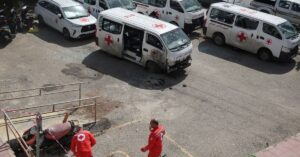
The ICRC called the back-to-back attacks on humanitarian personnel in southern Lebanon “gravely concerning,” as the war’s death toll surpassed 2,000 and fierce ground fighting engulfed the symbolic city of Bint Jbeil — even as Israel and Lebanon prepared for landmark peace talks in Washington.
Lebanese Red Cross staff inspect damaged ambulances at the Tyre headquarters following a drone strike on April 13, 2026. (Reuters / Louisa Gouliamaki)
killed in Lebanon since March 2
people displaced across Lebanon
medical workers killed in strikes
wounded since war began
The International Committee of the Red Cross issued one of its most urgent warnings yet on Monday, declaring it was “deeply concerned” and “gravely alarmed” after consecutive strikes hit Lebanese Red Cross personnel over two days — killing a long-serving volunteer and damaging the humanitarian organisation’s headquarters in the southern coastal city of Tyre. The incidents, coming within 24 hours of each other, drew immediate international condemnation and raised fresh questions about the protection of medical workers in a conflict that has already claimed the lives of at least 87 healthcare personnel since fighting began on March 2, 2026.
The back-to-back attacks represent a stark escalation in the toll being exacted on Lebanon’s emergency response infrastructure, as Israeli ground forces intensified their offensive against Hezbollah across the south and diplomatic efforts to end the war gathered pace ahead of scheduled talks in Washington on Tuesday.
“The loss of those who dedicate their lives to saving others is gravely concerning, given the impact on the civilians who depend on their help. Humanitarian and medical personnel must be protected.”
— Agnès Dhur, Head of ICRC Delegation, Lebanon
Volunteer Hassan Badawi Killed in Bint Jbeil Drone Strike
On Sunday, April 13, the Lebanese Red Cross confirmed the death of volunteer Hassan Badawi, who succumbed to wounds suffered after an Israeli drone struck the district of Bint Jbeil in southern Lebanon. Badawi had served the Lebanese Red Cross since 2022, dedicating years to delivering emergency medical care in one of the country’s most dangerous frontline regions. His death sent a wave of grief through Lebanon’s humanitarian community.
Badawi was laid to rest Monday in a temporary grave in Choueifat, a town south of Beirut, because intense fighting made it impossible to transport his body to his home village of Sultaniyah in the Bint Jbeil district. His mother, Ahlam Badawi, broke her silence at the funeral, attended by colleagues, mourners, and journalists. “I was waiting for a phone call from him to tell me, ‘Mother, I’m fine,'” she told reporters, her voice breaking. “He didn’t call me. My heart was burning.” His father, Ali Badawi, added: “They attacked him directly. He was just doing humanitarian work. He was not doing anything more.”
Israel’s military stated it had struck a “Hezbollah terrorist” in the area and said the incident was under review after it received reports that a Red Cross team had been caught in the strike. The divergence between that account and the Lebanese Red Cross’s version — that Badawi was on a humanitarian mission — has deepened tensions over Israel’s obligations under international humanitarian law regarding the protection of clearly marked medical personnel.
Tyre Red Cross Centre Hit in Monday Strike
The following day, Monday, April 14, a second strike hit the Lebanese Red Cross centre in the district of Tyre, one of Lebanon’s most historically significant coastal cities and a key hub for emergency response operations in the south. Lebanon’s state news agency, the National News Agency (NNA), reported that the strike — which it attributed to Israel — killed one person and damaged multiple Lebanese Red Cross vehicles and a building on the compound.
Reuters photographs from the scene showed staff clearing shattered glass from floors strewn with debris, while damaged ambulances — their distinctive red crosses clearly visible — sat crumpled in the compound’s courtyard. Three workers were slightly injured in the incident. The ICRC stated that it did not comment on the identity of the victim or on who was responsible for the strike, in keeping with its traditional policy of discretion in conflict zones. Israel’s military said it had conducted a targeted strike on a “Hezbollah terrorist” in Tyre and was investigating reports that the strike had caused damage to the Red Cross facility.
“Saving lives must never cost a life. They must be allowed to reach and help the wounded and return unharmed.”
— Agnès Dhur, ICRC Head of Delegation in Lebanon
ICRC Demands Protection Under International Humanitarian Law
In a formal statement issued from Geneva, Agnès Dhur, the ICRC’s head of delegation in Lebanon, warned that the pattern of attacks on medical workers was placing civilian lives at catastrophic risk. “The loss of those who dedicate their lives to saving others is gravely concerning, given the impact on the civilians who depend on their help,” she said. “Humanitarian and medical personnel must be protected. They must be allowed to reach and help the wounded, and return unharmed.” In a separate remark reported by the Associated Press, Dhur distilled the ICRC’s position into a stark moral statement: “Saving lives must never cost a life.”
Under the Geneva Conventions — the foundational framework of international humanitarian law — medical personnel, facilities, and vehicles bearing the Red Cross or Red Crescent emblem are explicitly protected from attack. Deliberately targeting them constitutes a war crime. The ICRC, as the guardian of the Geneva Conventions, has repeatedly called on all parties in the Lebanon conflict to uphold these obligations. The killing of 87 medical workers since the war began underscores how far those protections have broken down on the ground.
- The 2026 Lebanon war began on March 2, when Hezbollah fired rockets into Israel in support of Iran, triggering Israeli airstrikes and a ground campaign.
- Lebanese Red Cross volunteer Hassan Badawi was killed on Sunday, April 13, by an Israeli drone strike in the Bint Jbeil district of southern Lebanon.
- A strike — attributed by Lebanon’s NNA to Israel — hit the Lebanese Red Cross headquarters in Tyre on Monday, April 14, killing one and injuring three workers.
- The ICRC’s Agnès Dhur declared the consecutive strikes on humanitarian workers “gravely concerning,” warning of catastrophic impact on civilians needing aid.
- At least 2,055 people have been killed in Israeli strikes in Lebanon, including 252 women, 165 children, and 87 medical workers, with 6,588 wounded.
- Over one million Lebanese — nearly 20% of the country’s population — have been displaced since the war began, one of the world’s fastest-growing displacement crises.
- Israeli forces completely encircled the strategic city of Bint Jbeil on April 13, launching a ground assault and claiming to have killed over 100 Hezbollah fighters in a week.
- The World Health Organization warned that hospitals in southern Lebanon face depletion of vital medical supplies within days due to the destruction of Litani River bridges.
- Israel and Lebanon’s ambassadors to the United States were scheduled to meet in Washington on Tuesday, April 15, in the first direct negotiations of the war.
- Israel said it aims to establish a “security zone” in southern Lebanon up to the Litani River, roughly 20 miles from the Israeli border, as a buffer against future Hezbollah attacks.
Battle of Bint Jbeil: A City of Deep Symbolic Weight
The killing of Hassan Badawi and the broader Israeli ground offensive are inseparable from the intensifying battle for Bint Jbeil, a city of profound symbolic and strategic importance. It was from Bint Jbeil’s stadium in 2000 that Hezbollah’s late secretary-general Hassan Nasrallah delivered his famous “Liberation” speech, celebrating the Israeli military’s withdrawal from southern Lebanon after 22 years of occupation. The city has long been described by Hezbollah as the “capital of resistance.” Israel’s military shared satellite imagery on Monday showing that the historic stadium had apparently been destroyed in a strike — a deliberate move that analysts interpreted as an attempt to erase the symbolic landscape of Hezbollah’s political identity.
Israel’s 98th Division — an elite unit specialised in urban combat — completed the encirclement of Bint Jbeil on April 13 and announced the start of an assault on the town. The Israeli military’s Arabic-language spokesman, Colonel Avichay Adraee, announced on social media that forces had “completed the encirclement of the town of Bint Jbeil and have begun an assault on it.” Israeli Prime Minister Benjamin Netanyahu told his Cabinet on Monday that the military was expanding operations, and IDF Chief of Staff Eyal Zamir declared the military was in a “state of war” in Lebanon, even as a ceasefire held with Iran.
Hezbollah has fought back fiercely, claiming multiple attacks on Israeli armoured units and infantry with rockets, artillery, and drones. Lebanese security sources, speaking to international media, alleged that Israeli forces were using warplanes, artillery, and phosphorus bombs in the battle. Israel has denied targeting civilians or using illegal munitions. Fierce street-by-street combat has been reported in the town’s neighbourhoods, with Lebanese sources stating that the IDF had not yet seized the town’s central “landmark” — the stadium — as of Monday morning.
Humanitarian Crisis Deepens: Hospitals at Breaking Point
The strikes on Red Cross personnel are the sharpest expression of a deepening humanitarian catastrophe that has overwhelmed Lebanon’s already strained infrastructure. The World Health Organisation sounded the alarm this week that hospitals in southern Lebanon face depletion of critical life-saving supplies within days. Israel’s earlier destruction of the main bridges over the Litani River — a strategic move to cut off Hezbollah’s resupply routes — has also severed the primary arteries through which humanitarian aid reaches the south, leaving communities isolated and emergency workers unable to move freely.
Since March 2, Israeli forces have launched more than 1,840 documented attacks on Lebanon, according to the Armed Conflict Location and Event Data project (ACLED). Israel’s evacuation orders now cover more than 1,470 square kilometres — roughly 14 percent of Lebanon’s total territory — affecting hundreds of thousands of civilians. The Norwegian Refugee Council described Lebanon’s displacement figure of over one million people, including 350,000 children, as one of the worst displacement crises recorded globally in recent years. Makeshift camps have emerged along Beirut’s waterfront, where internally displaced families live in tents in plain sight of the Mediterranean.
Diplomatic Race Against the Clock: Washington Talks Loom
The tragedies unfolding on the ground are set against an increasingly urgent diplomatic backdrop. Lebanon and Israel’s ambassadors to the United States were due to meet in Washi